
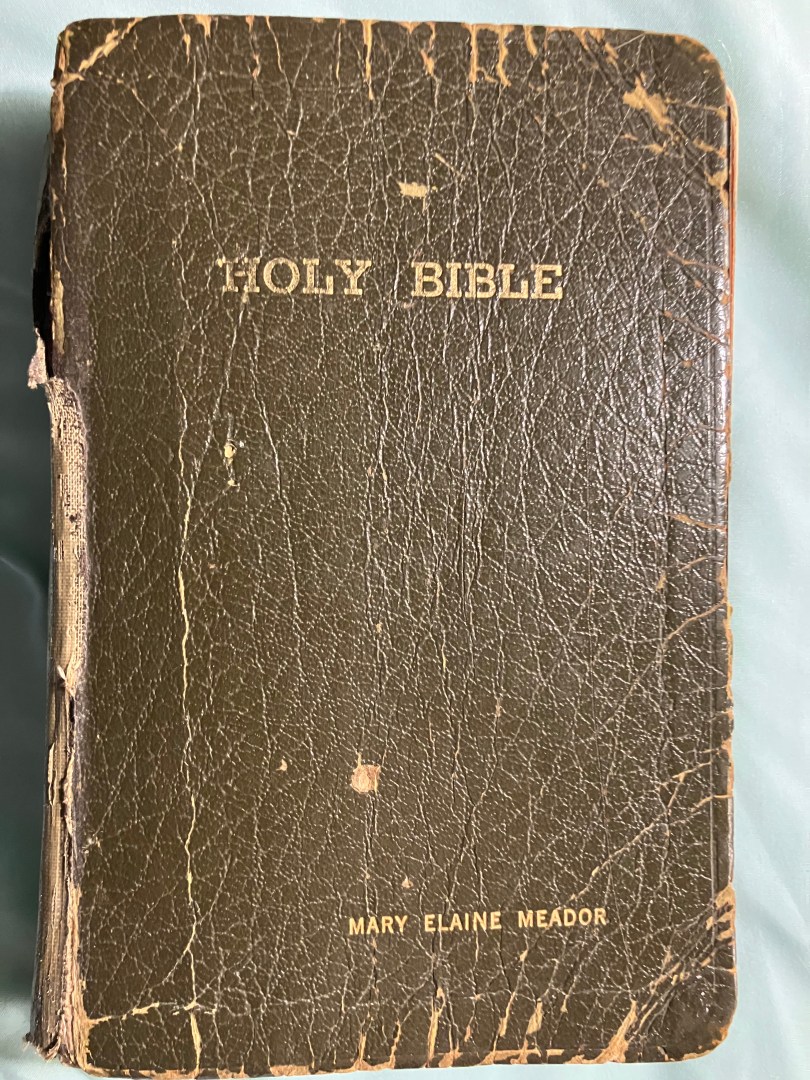
The Bible pictured above was the first Bible I received as my very own. My paternal grandfather gave it to me for my seventh birthday. I was actually not thrilled with the color, but I was very excited to have a Bible of my own with my name on it, just like my parents’ Bibles. And I used it a lot.
That Bible was a small part of the heritage I received from my grandfather. I recently read an autobiography he wrote, mostly looking for more information about my father’s early years. I kind of knew his story, but reading it still surprised me. He was the middle living child and second son of his mother, who was the second wife of a much older man. My great-grandparents had married at ages 69 and 25. There were some much older half-siblings who seem to have been good influences in my grandfather’s life.
Unsurprisingly, my great-grandfather passed away when my grandfather was still a child. His mother remarried, but died about a year later, when my grandfather was just 13. It’s clear that the step-father was not willing to take on the task of raising the children, and his siblings seem to have been shuffled about among family quite a bit, though the youngest eventually ended up in the Baptist Children’s Home. Granddad describes living with several different family members, but was clearly always expected to pay his way with work, either bringing in money from outside or working for the family farm or business. This is not something he ever complained about; it’s just evident from the description, and it was not uncommon at the time.
Through a friend who was a Western Union messenger boy, Granddad began getting some earning opportunities with them, without letting them know he was actually too young, and eventually became the new messenger boy when the friend moved on to bigger and better things. He describes fitting his full work week around his high school schedule and paying for his first bicycle out of his earnings. Here we see the work ethic that exemplified much of my grandfather’s life and enabled his climb to the AVP of Sales role at Western Union that he lacked the college degree for. That same work ethic was deeply ingrained in my father and passed on to me and my sister.
As Granddad described his moves up into management, it’s clear that he worked to exemplify the kind of servant leadership that was evident in my father’s leadership style.
In looking at Granddad’s life, I also see where Dad got his absolute need to move and travel. My grandparents moved frequently during my father’s youth, living in several states and often moving from one rental to another within any given town or city. During Dad’s pre-teen and early teen years, Granddad was a district sales supervisor and was on the road much of the week. During summer, Dad often traveled with him. So we can probably attribute my constant moves as a young person to my grandfather.
Not every part of that heritage is positive. There were strong tempers in my paternal grandparents’ house, and a lot of yelling. That particular legacy was one my father struggled to overcome throughout his life, and I still work on it in myself.
The most important part of the heritage I received from those grandparents (really both sets of my grandparents) was a tradition of faith and service. My grandparents loved the God who made and loved them. They helped to instill in my father the love of God and concern for missions that became the center of most of his life.
My grandfather taught me about Christian service through action. I remember going with him to help set up for services at his little church in Ramsay, New Jersey. This man was someone reasonably important and very successful in his role at work, but he was also willing to spend extra time early at church just to get things set up.
I have been blessed to have an earthly legacy of faith and Christian service. I know that not every believer has that blessing. Some don’t know much about their heritage. Some must walk away from aspects of their earthly heritage to walk toward Christ. I really can’t speak to those circumstances except to offer three truths.
First, I have an opportunity today to influence the heritage of my children, grandchildren, my niece and nephew, and their children.
You shall therefore lay up these words of mine in your heart and in your soul, and you shall bind them as a sign on your hand, and they shall be as frontlets between your eyes. You shall teach them to your children, talking of them when you are sitting in your house, and when you are walking by the way, and when you lie down, and when you rise. Exodus 11:18-19
Second, heritage doesn’t have to be about blood. I hope that I have provided a legacy that matters to many of my students and younger co-workers. We all come in contact with other humans and can offer them interactions that provide love and godly influence. We think of Paul’s influence on Timothy, of Barnabas’s apparent influence on John Mark. We know that Timothy, in particular, had a believing mother and grandmother, but Paul claims a fatherly influence: “But you know Timothy’s proven worth, how as a son with a father he has served with me in the gospel.” Philippians 2:22 ESV
Third, all who claim Christ have an amazing spiritual heritage. We have been named fellow heirs with Christ. All of us, whether our earthly legacy seems more positive or more negative, should look to that as the most important heritage.
For all who are led by the Spirit of God are sons of God. For you did not receive the spirit of slavery to fall back into fear, but you have received the Spirit of adoption as sons, by whom we cry, “Abba! Father!” The Spirit himself bears witness with our spirit that we are children of God, and if children, then heirs—heirs of God and fellow heirs with Christ, provided we suffer with him in order that we may also be glorified with him. Romans 8:14-17 ESV
I hope that you will join me in celebrating the inheritance we have with Christ, reflecting on our earthly legacies, and seeking to share that inheritance with others.
 Faith Musings