
Perspective

At one point, I had a student contact me the day before an exam to say that a close friend of his had passed away earlier in the week and that he would take the exam the next morning if he had to but he would really appreciate being allowed to take it a few days later.

There is no policy about the death of friends at my university. Family deaths, yes. Serious illness, yes. Religious observations, yes. This situation, no.

I had to decide how to handle the situation. I know faculty who would have made the student take the test at the planned time. I hope I would never have been one of them, but at this point in my life, there was really no question. You see, I know what it is to be the mother of a college student who has lost a close friend. I instantly saw the situation not only from the perspective of the policy-following professor concerned about fairness, but also from the perspective of a mother who knows the trauma of such a loss and how it can impact a student’s ability to function.

As humans and as Christ-followers, it is valuable for us to see things from the perspectives of others. When we understand other people’s values and experiences, we can minister to their needs more effectively, better recognizing what is helpful, and what is insulting, and what is enabling patterns of poor choices. We can share the gospel with them in more understandable ways. 

Jesus demonstrates this in his interactions with people, diving to the heart of the problem of the rich young ruler’s love of his wealth (Mark 10:17-31), weeping with Mary over the death of Lazarus (John 11:28-37). Even his first miracle of turning water to wine is evidence that he takes others’ perspectives into mind, since he performs the miracle even after telling his mother that it was not his time (John 2:1-10).

Paul demonstrates the adjustment of the gospel presentation in his letters, which speak to the different needs of the churches who receive them. We also see that he speaks very differently to the Athenians at the Areopagus (Acts 17:16-34) than he does to King Agrippa, who has an understanding of and belief in Scripture (Acts 26).

We also need to seek to understand the perspectives of those around us, to ask why they think and act as they do, to shape our presentation of truth and aid to reach people where they are.

Even more than recognizing and understanding the perspectives of the people around us, however, we need to seek to recognize, understand, and adopt God’s perspective on pretty much everything.

We are prone to see the world from a very self-centered place: how will this situation change my life? How does this change increase or decrease my taxes? I’m uncomfortable talking to strangers, so why should I do that?

God makes it very clear that our perspectives are not his:

For my thoughts are not your thoughts,
    neither are your ways my ways, declares the Lord.
For as the heavens are higher than the earth,
    so are my ways higher than your ways
    and my thoughts than your thoughts.

Isaiah 55:8-9 ESV

As Christians, we are called to do better, to allow God to adjust our thinking, to leave behind our self-centered perspectives. Part of the new life is supposed to include new ways of thinking.

Do not be conformed to this world, but be transformed by the renewal of your mind, that by testing you may discern what is the will of God, what is good and acceptable and perfect.

Romans 12:2 ESV

The natural person does not accept the things of the Spirit of God, for they are folly to him, and he is not able to understand them because they are spiritually discerned. The spiritual person judges all things, but is himself to be judged by no one. “For who has understood the mind of the Lord so as to instruct him?” But we have the mind of Christ.

1 Corinthians 2:13-16 ESV

How do we do that? Much as we do it with other humans. We have to spend time with them. We must also spend time with God. We must learn about other people’s values in order to understand their actions. We must learn about God’s values. We must read and know the stories that God has given us that tell of his actions in regard to the world and to his people, both Israelites and Christians.

We must, in fact, do exactly what we are repeatedly called to do: study and meditate on the Bible, which is our record of God’s values, instructions, and actions. Then we must work to consistently adopt those values as our own and follow those instructions. 

As our own values and actions become reflections of his, we can more effectively communicate them with others. As we adjust our personal perspective to match God’s, we will find it easier and easier to also recognize and respond appropriately to the perspectives of other humans, just as God does.

Freedom in Christ

As followers of Christ, we have amazing freedom. That is a truth that echoes through the New Testament.

So Jesus said to the Jews who had believed him, “If you abide in my word, you are truly my disciples, and you will know the truth, and the truth will set you free.”

John 8:21-32 ESV

For freedom Christ has set us free; stand firm therefore, and do not submit again to a yoke of slavery. Galatians 5:1 ESV

Galatians 5:1 ESV

Now the Lord is the Spirit, and where the Spirit of the Lord is, there is freedom.

2 Corinthians 3:17 ESV

We have been freed from sin, from lies, from the law.

We know that our freedom is not without limits. Paul spends much of the 6th chapter of Romans explaining that our liberty is not a license to do as we wish in regard to sin.

But thanks be to God, that you who were once slaves of sin have become obedient from the heart to the standard of teaching to which you were committed, 18 and, having been set free from sin, have become slaves of righteousness.

Romans 6:17-18 ESV

Peter makes the same point:

Live as people who are free, not using your freedom as a cover-up for evil, but living as servants of God.

1 Peter 2:16 ESV

This is a truth that most of us accept without difficulty. We struggle with sin at times, but we know that part of our response to God’s gift of freedom and life is supposed to be turning away from our sin, avoiding wrong-doing.

The question follows: what about things that aren’t sin? Are there limits to our freedom when sin is not involved?

No, and yes.

If what I wish to do is not sin, I am free to do it. However, there are times when I can and should limit my own freedom for the benefit of fellow Christians or for the benefit of unbelievers.

Paul uses the example of eating meat offered to idols to make this point regarding other believers. That example doesn’t make much sense to us today, with meat freely available in supermarkets and few worship practices that involve slaughtering animals. In Paul’s day, sacrificing animals was a common act of worship, not only in Judaism but also in the worship of various idols. Some of the meat from those sacrifices was then made available for people to eat.

Paul makes the point that if the believer’s intent in eating the meat is just to eat the meat and his or her attitude is one of thankfulness to God, there is no sin. There’s nothing wrong with the act of eating the meat itself. Not everyone could separate that act from their experiences of previous idol worship, however. 

Food will not commend us to God. We are no worse off if we do not eat, and no better off if we do. But take care that this right of yours does not somehow become a stumbling block to the weak. For if anyone sees you who have knowledge eating in an idol’s temple, will he not be encouraged, if his conscience is weak, to eat food offered to idols? And so by your knowledge this weak person is destroyed, the brother for whom Christ died. Thus, sinning against your brothers and wounding their conscience when it is weak, you sin against Christ. Therefore, if food makes my brother stumble, I will never eat meat, lest I make my brother stumble.

1 Corinthians 8:8-13 ESV

Paul says very bluntly that eating the meat in front of someone whose faith would be weakened by seeing it is wrong, is sin, even though eating the meat isn’t sin in and of itself.

If what we are doing may weaken the faith of another, we should limit our freedom and refrain from doing it, even if the thing itself is not wrong.

Paul also talks about limiting our freedom in relation to the conduct of gatherings of believers, saying that we should not simply say and do as we wish in our worship of God, but should consider the impact on other believers and on non-believers who might come into our gatherings. 

If, therefore, the whole church comes together and all speak in tongues, and outsiders or unbelievers enter, will they not say that you are out of your minds? But if all prophesy, and an unbeliever or outsider enters, he is convicted by all, he is called to account by all, the secrets of his heart are disclosed, and so, falling on his face, he will worship God and declare that God is really among you.

1 Corinthians 14:23-25 ESV

Paul speaks most about the impact of speaking in tongues because it is something that benefits the person doing the speaking and not those who don’t understand what is said. However, he also talks about the gathering time having order and purpose in general, so that it is to the benefit of all.

Clearly, nothing that Paul speaks of refraining from in 1 Corinthians 14 is a sin. It’s all about worshipping God using the spiritual gifts we’ve been given. At the same time, we must not abuse the freedom we have to the detriment of either our fellow believers or those who we should be seeking to lead to Christ.

Paul stated the general principle in regard to unbelievers quite clearly:

 For though I am free from all, I have made myself a servant to all, that I might win more of them.

1 Corinthians 9:19 ESV

As we revel in the freedom that we have in God, we also need to consider all of our actions. How do the things that we do each day impact those around us? Are we strengthening other believers? Are we demonstrating the character of God to everyone? Are we, instead, taking actions that lead non-believers to think that we don’t care about them?

Like Paul we must consider our actions in light of their impact on those around us. Our freedom is worth nothing next to the spiritual well-being of those around us.


Photo by Hanxiao on Unsplash

Temples

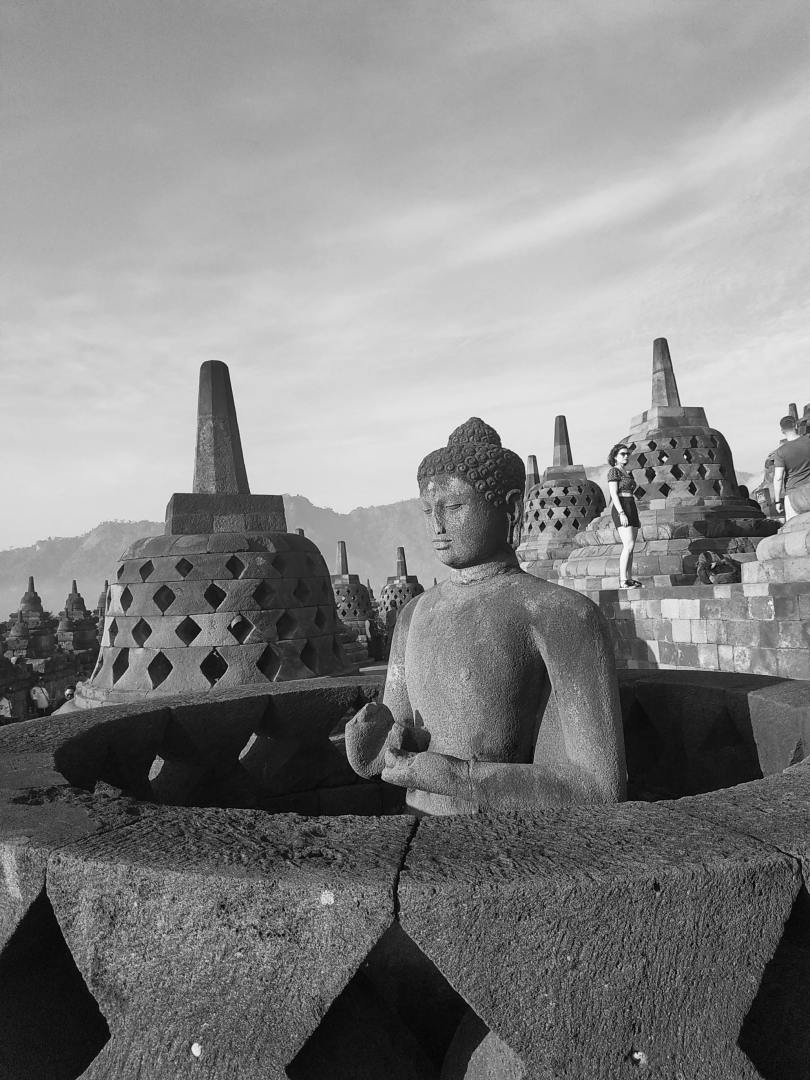
In the course of my life, I have been privileged to visit a few temples, most of them Buddhist, both those now in use and those that are now tourist sites. I’ve explored Borobudur in Central Java, seen the Emerald Buddha and the Reclining Buddha among others in Thailand. I’ve watched the monks and other worshippers in a temple in Xining. I’ve stood in the Pantheon in Rome and imagined what it was like when still dedicated to the Roman gods. I’ve seen the remains of other temples: in the museum in Cairo, in the Louvre, in the British Museum.

One thing that strikes me about temples is that you can’t miss who or what they’re dedicated to. There’s just no question. The decor, the behavior of the worshipers, and often the architecture itself makes it clear.

This is also true also of the Jewish temples, beginning with the tabernacle. My current Old Testament reading is in Ezekiel where he is being shown the temple. Those chapters remind me of the meticulous (and long) instructions God gives Moses for the tabernacle. Everything about the tabernacle is laid out clearly. Every bit of the design has purpose, all of it eventually centered on the Holy of Holies.

As Christians, we don’t build temples. We build gathering places. There’s a reason for that. We are told quite clearly that we ourselves are the temples.

Do you not know that you are God’s temple and that God’s Spirit dwells in you? If anyone destroys God’s temple, God will destroy him. For God’s temple is holy, and you are that temple.

1 Corinthians 3:16-17 ESV

Or do you not know that your body is a temple of the Holy Spirit within you, whom you have from God? You are not your own, for you were bought with a price. So glorify God in your body.

1 Corinthians 6:19-20 ESV

We ourselves are the temples of God, of the Holy Spirit? What does that mean for us?

The first passage is found in the midst of Paul calling out the Corinthians for claiming to follow Apollos or Paul instead of focusing on following Christ himself. Paul describes his work and that of Apollos as working to build the believers into buildings that will stand the test of fire. The implication here is that we are being formed into worthy temples of God.

The second passage comes after an extended diatribe against sexual immorality. Paul’s point here is pretty clearly: “Your body is a temple dedicated to the Holy Spirit. Don’t sin with it.

A central concept underlying both of these points is this: if we are a temple of God, people should be able to tell. We must ensure that our bodies, and our entire selves, reflect the entity to whom we are dedicated. Our actions, our words, and everything else about us should represent the God we claim to serve and worship.

Just as any casual tourist can easily see that Borobudur was dedicated to Buddha and his teachings, those who interact with us should see who we belong to.

That goes beyond each of us as individuals as well, for it is not just each separate Christ-follower who is a temple.

So then you are no longer strangers and aliens, but you are fellow citizens with the saints and members of the household of God, built on the foundation of the apostles and prophets, Christ Jesus himself being the cornerstone, in whom the whole structure, being joined together, grows into a holy temple in the Lord. In him you also are being built together into a dwelling place for God by the Spirit.

Ephesians 2:19-22 ESV

Therefore, we must work, both within our own selves and as a body of believers, to ensure that we are growing into worthy temples who reflect God.


Photo by Leo Chandra on Unsplash

In the Middle

This is not the post I had planned to write this week. That one will come later, but it was a post about dealing with old wounds and former pain. This week, I’m not in the place to do that, because I find myself too much in the middle of new problems and current pain.

Some of the week’s stresses are just my current job situation, exacerbated by the recent flood of my office and the decision to abate asbestos on that floor during repairs, meaning that I have to pack up the office and have a smaller temporary space somewhere for the rest of the semester. Not a huge deal, since I’m primarily working from home this semester, but a bit unsettling not to have my usual office space and things available at need. And, of course, not convenient to have to deal with packing things up in the midst of an already too busy semester.

Then one of my sons called. That is not my story to tell, but I will say that it was not good and it did involve him coming to stay with us while looking for a new place to live. There is good news. He has found a new place which looks like it will be a good fit for his circumstances. The other problems that led to the crisis, however, will be with us all for some time to come.

So I and my family find ourselves in the middle of turmoil, where it is sometimes easy to call out and cling to God, but also easy to cry out in frustration and blame.

I often turn to the Psalms at times like this. Many of them contain cries of protest and cries for help born out of struggles and pain, mingled with reminders and gratitude that God is in control and he does care.

This time, my son drew my attention to Micah 7. Micah describes a world of barrenness, struggle, and mistrust. Then he declares:

But as for me, I will look to the Lord;
    I will wait for the God of my salvation;
    my God will hear me.
Rejoice not over me, O my enemy;
    when I fall, I shall rise;
when I sit in darkness,
    the Lord will be a light to me.
Micah 7:7-8 ESV

This is the response we need to have when we’re in the middle of the struggle, still dealing with the chaos of life. God will hear us. He will be our light when we look to him—when we wait for him.

I usually find it easy to stop and pray for a short time when the problem happens. That’s especially true when the problem is a big deal because those stop me in my tracks and force me to look up from the tasks of my day. I personally struggle with the waiting and continued prayer. I want to do things, to fix the situation, to exert control.

The answers, the salvation, are not in my control but are in God’s hands. My prayer for myself, my family in our current struggles, and all of you in the problems you find yourself in the middle of, is one of Paul’s: “May the God of hope fill you with all joy and peace in believing, so that by the power of the Holy Spirit you may abound in hope” (Romans 15:13 ESV).

What we feel in the middle of our problems is not reality. God can and will provide hope and help to see us through to the other side.

New Life

One thing I love about being a university professor is that a significant part of my job is constantly renewed. The previous semester is gone. Some of it was good; some of it was less good; all of it is in the past and can’t be changed. Now I have a new semester ahead in which to give my students the best experience and instruction that I can manage. I have new students, sometimes new material, new approaches to try. While the new can bring challenges, it also brings excitement and an opportunity to do even better by this next group of students.

Newness is also one of the exciting things about a life spent following Jesus Christ. The Bible is very clear that when we accept Christ, when we make that choice to acknowledge and turn away from our sin and obey God instead of our own desires, we are made new. Paul’s expression of that concept may be the most familiar to us: “Therefore, if anyone is in Christ, he is a new creation. The old has passed away; behold, the new has come” (2 Corinthians 5:17 ESV). Elsewhere he emphasizes again that our old lives are dead and gone: “We were buried therefore with him by baptism into death, in order that, just as Christ was raised from the dead by the glory of the Father, we too might walk in newness of life” (Romans 6:4 ESV).

Many other verses emphasize that we were dead in our sin and that God has given us a new life and made everything new.

Unfortunately, we sometimes lose sight of God’s amazing regeneration of our souls and lives. We may look back and appreciate that one-time deal, but we don’t always live in our new life as we plod along on earth.

I think this is partly because we’ve missed the magnitude of the renewal that God offers us. The first great change is an amazing transformation, but God also calls us to a constant refreshing, a repeated renewing of hearts and minds. He calls us to sing new songs several times in the Psalms. We need new songs because they refresh us and renew our praise for God and our joy in him. In the midst of great sorrow, Jeremiah proclaims, “The steadfast love of the Lord never ceases; his mercies never come to an end; they are new every morning; great is your faithfulness” (Lamentations 3:22-23 ESV).

We can see God’s willingness to renew and restore simply by reading the history of the nation of Israel in the Old Testament. He repeatedly rescues the Israelites from the consequences of their bad actions and restores them as his people, until they stray again.

How do we take advantage of God’s offers of renewal? How do we live as the new and constantly renewed creatures that we should be as followers of Jesus Christ?

The key is in that last phrase. Jesus gave us the instructions we need to follow. “And he said to all, “If anyone would come after me, let him deny himself and take up his cross daily and follow me” (Luke 9:23 ESV). We too often treat our choice to follow as a single event. Rather, we are called to make the conscious choice every day.When we do make that constant, conscious choice to submit to God and follow him, we will receive the renewal promised. We are told: “but they who wait for the Lord shall renew their strength; they shall mount up with wings like eagles; they shall run and not be weary; they shall walk and not faint” (Isaiah 40:31 ESV).


Photo by Joshua J. Cotten on Unsplash

Working for a Reason

It is a busy time of year for me, even more so than usual in 2020. Classes start in a week at my university, and I’m teaching in new ways, including switching from partially in person to 100% online for one of my courses in just the last week. I’ve also agreed to serve on far too many committees again. As I sit in front of my computer and look at the lengthy list of things that I had hoped to have already finished in order to make the semester go smoothly, I find myself looking for the motivation to keep going.

I know I have it easy compared to many. My work is not usually challenging physically, though it can be taxing in terms of time spent and the mental and emotional energy required. It’s also inherently deeply rewarding. I get to know with absolute certainty that I have changed people’s lives for the better.

Still, there are days when I just want to put all of it away and hide somewhere with a good book.

Where do we find the motivation to keep going and do our work well? There are many human answers to that. 

Food and shelter are important, and the Bible encourages us to work for that reason: “For even when we were with you, we would give you this command: If anyone is not willing to work, let him not eat. For we hear that some among you walk in idleness, not busy at work, but busybodies. Now such persons we command and encourage in the Lord Jesus Christ to do their work quietly and to earn their own living” (2 Thessalonians 3:10-12 ESV).

Those of us who are fortunate enough to have jobs that we love will put in the effort simply out of love of the task itself and concern for those who benefit from our efforts.

Some of us also do our work well out of a sense of obligation, loyalty, or honor.

All of these things help, but we may find there are days when they are not enough to keep our attitude positive and our focus where it should be.

The problem with all of these things is that they miss the real point.

Whatever you do, work heartily, as for the Lord and not for men, knowing that from the Lord you will receive the inheritance as your reward. You are serving the Lord Christ. (Colossians 3:23-24 ESV)

I am serving the Lord Christ. Not my students. Not my department chair. Not my dean or even the university president. Not my profession. Certainly not my own reputation. The purpose behind everything I do is to serve Jesus.

The question is whether I really believe that and act that way. If I understand that I am serving Jesus, then the whole picture changes. What am I doing grumbling about work that honors my savior? Why does it matter that I have done this task a hundred times before if I am honoring God in the doing? If my project is completely changed, rendering all of my work useless, do I complain, or realize that all of the time spent was worthwhile because I did it all well with Christ in mind? If I do the work for Christ, these are opportunities for growth, not sources of frustration.

While this passage is valuable for all believers, the point is emphasized by the context. Paul is talking to slaves, people with few choices. They could not ask for a different role. They could not leave a job because it wasn’t a good fit. Paul calls on the powerless people to understand that their work is not for their owners, but for Jesus Christ.

In our current world, some of us have little choice in how we spend our time, while others have greater options. All of us have hard days, but we can make those days more rewarding by choosing to do all that we do for our Lord above all else.


Photo by Trent Erwin on Unsplash

When What’s Best Is Hard

I have a love-hate relationship with my CPAP. On the one hand, I know it helps. Once I get to sleep at night, I sleep much better, waking up less frequently. I’m not tired all the time. I’m no longer afraid to sleep because I might stop breathing. I don’t wake up into bad tachycardia episodes. Using the CPAP every night has changed my life and may have lengthened it. It’s great!

On the other hand, the CPAP is not terribly comfortable. If I’m having a rough time getting to sleep, the CPAP just makes it worse. If it’s not tight enough, there’s the noise and the bits of wind in my eyes. Since I fix it so that it is tight enough, there are lines on my cheeks every morning where the straps cross my face. Quite frankly, I don’t like the thing.

But I wear it–every night–because I know it’s essential for my physical health.

There are times when following Jesus can be like that; not always pleasant, sometimes really painful. Always, however, best for our spiritual health.

Paul tells the story of his “thorn in the flesh”:

So to keep me from becoming conceited because of the surpassing greatness of the revelations, a thorn was given me in the flesh, a messenger of Satan to harass me, to keep me from becoming conceited. Three times I pleaded with the Lord about this, that it should leave me. But he said to me, “My grace is sufficient for you, for my power is made perfect in weakness.” Therefore I will boast all the more gladly of my weaknesses, so that the power of Christ may rest upon me. For the sake of Christ, then, I am content with weaknesses, insults, hardships, persecutions, and calamities. For when I am weak, then I am strong. (2 Corinthians 12:7-10 ESV)

We don’t know what Paul’s thorn was. We do know that it was unpleasant. Unpleasant enough that he “pleaded” three times for God to remove it. God doesn’t remove it. Instead, he tells Paul that his weakness is for the best, because God’s power can work perfectly in him because of his weakness. 

As Christians, we can be tempted to believe that we shouldn’t have to put up with the bad things, the hard things, in life. After all, we serve the Creator, the Healer, the Provider. He made us and the world, so he can make everything good. He can heal anything. He can provide every need and want we have. The Bible tells us that he “will wipe away every tear.”

We miss the context. Jesus will wipe our tears away in the new heaven and earth: “He will wipe away every tear from their eyes, and death shall be no more, neither shall there be mourning, nor crying, nor pain anymore, for the former things have passed away” (Revelation 21:4 ESV). This comfort and freedom from sadness and pain are a promise for the next life, not for this one.

Jesus said that he has overcome the world, right after a warning about the hard times coming: “In the world you will have tribulation. But take heart; I have overcome the world” (John 16:33b ESV). We’re still in the world, and we’re still going to face the troubles of being here. Jesus promises to be with us and bring us peace in the troubles. He doesn’t promise to keep us comfortable. Even human parents will sacrifice their children’s happiness for the sake of their safety and education.N God is much more concerned with our spiritual growth.

All of the good things are coming. Right now, we’re living in a world filled with brokenness and sin, and God is using our circumstances to mold us into the image of Jesus, to perfect his power in us. It’s not always fun. It’s definitely not always easy. As the author of Hebrews points out: “For the moment all discipline seems painful rather than pleasant, but later it yields the peaceful fruit of righteousness to those who have been trained by it” (Hebrews 12:11 ESV).

When we focus on the things we want God to provide, especially the material things and comforts, we lose sight of what matters. We become weaker spiritually, and we miss out on the abundant life he offers us now. 

We need to understand that what is needed for our spiritual health can sometimes be hard and unpleasant. We must learn to accept what God allows into our lives and welcome his power at work within us. Then we will experience all the benefits of his life in us both now and in that place where pain and sorrow will be gone.


Photo by Aliyah Jamous on Unsplash

Held

I am very grateful to be spending the pandemic with my husband of 35 years. Admittedly, having two of us working from home has posed some challenges, as has spending almost all of our time in the same house. However, the ability to turn to the other and say, “Hug?” with the absolute assurance that a hug will be provided is beyond price. Being held in the arms of someone I know loves me, even when we’ve just been having a disagreement, provides comfort and security that can be hard to find in our current turbulent world.

As much as I value the feeling of being held by my husband, some of that security is illusory. There is much that he cannot protect me from, no matter how much he might wish to. 

I am deeply grateful that I am also loved by one who truly can stand against anything and whose love can never be overcome. Paul put it most eloquently: 

For I am sure that neither death nor life, nor angels nor rulers, nor things present nor things to come, nor powers, nor height nor depth, nor anything else in all creation, will be able to separate us from the love of God in Christ Jesus our Lord. (Romans 8:38-39 ESV)

I may lose sight of God’s love. I may forget that I have this assurance. I may feel that earthly things are coming between me and God. Even when I allow things to interfere with my love for God, God’s love for me will stand. Always.

Even more than this, Jesus said he holds us and that no one can remove us from his grasp.

“My sheep hear my voice, and I know them, and they follow me. I give them eternal life, and they will never perish, and no one will snatch them out of my hand. My Father, who has given them to me is greater than all, and no one is able to snatch them out of the Father’s hand. I and the Father are one.” (John 10:27-30 ESV)

There is much to love in this passage. We hear Jesus, and we follow him, yet it’s not that we know him: he knows us. He knows us fully and completely, the good and the bad. Even so, he gives us eternal life and holds us securely. His love is not like ours, based on limited understanding, but rather a love that knows every flaw yet loves us more than anyone else ever could.

We are securely held by the one who is “greater than all.” No matter the challenges of life, no matter the hurt, no matter the loneliness: if we listen to Jesus and follow him, we’ll be in hands that are not just good, but perfect.

There’s a song by Casting Crowns that I love that talks about our tendency to be strong and try to control our circumstances when everything goes wrong. The name of the song is “Just Be Held,” and the message is to remember that God is still in control and holding us, so we need to “stop holding on and just be held.”

When everything is falling down around us, as it has been for many of us in these last few months, the answer is not in our strength but in the one who will always hold us.


Photo by Anastasia Sklyar on Unsplash

Finding Truth

Truth seems to be getting harder to come by in our world. Our social media feeds are full of fake news of all kinds. The political posts are easy to locate, of course. A few months ago, several of my Facebook friends posted a story about a politician’s tax proposal, expressing significant outrage. I felt compelled to debunk the story because it ignored how income tax rates actually work in the US. If we want to be outraged about a political candidate, we should all make sure that we’re being outraged about something that is real, not something that is simply inaccurate. Similarly, there have been plenty of posts about Covid-19 that can be proved false by doing the math.

Even setting aside politics, however, I find no lack of sensational stories that show up on my feed that have already been debunked by various fact-checking sites. They’ll disappear and then show up again a year or two later.

Why is that?

As we look at these stories, one thing that is true of all of them is that they are unusual or surprising. Most of them also invoke some other negative emotions: outrage, horror, disgust. It turns out that social media hasn’t caused some sudden change in humanity that makes us tell and listen to these stories. Rather, this is the same set of motivations that have set people whispering to one another about the actions of their friends and neighbors for the long history of our fallen world. In a word, it’s gossip.

Gossip is one of those sins that good, church-going Christians tend not to want to talk about much. After all, most of us have indulged in it on occasion. Sometimes we even use making prayer requests as an excuse for gossip: “Y’all, we need to pray for the Campbells. Their oldest daughter, Maisie, has been hanging around with the wrong crowd, and my youngest has heard that she’s been pale and having some trouble keeping her breakfast down, if you know what I mean.” Not all gossip-laden prayer requests are quite so blatant, but I would guess that most of us have at least heard a prayer request that was more gossip than legitimate request without trying to stop it. I would also speculate that some of us have shared a prayer request with details that weren’t ours to share, including details that were rumor more than fact.

Because most of us have indulged in gossip and we see it as harmless, idle talk, we tend to view gossip as a “lesser sin,” not something that we need to worry quite so much about confessing and avoiding. After all, Maisie Campbell’s sins are far greater and we’re much more concerned that she confess and repent. But what is God’s view of gossip?

And since they did not see fit to acknowledge God, God gave them up to a debased mind to do what ought not to be done. They were filled with all manner of unrighteousness, evil, covetousness, malice. They are full of envy, murder, strife, deceit, maliciousness. They are gossips, slanderers, haters of God, insolent, haughty, boastful, inventors of evil, disobedient to parents, foolish, faithless, heartless, ruthless. Though they know God’s righteous decree that those who practice such things deserve to die, they not only do them but give approval to those who practice them. (Romans 1:28-32 ESV)

We see gossip here in the middle of quite a list. Most things in these verses we quickly reject. We’re not evil, or God-haters, or malicious. We’re not going to murder anyone. However, Paul doesn’t distinguish among these different forms of sin. All of these things are “what ought not to be done.” All “who practice such things deserve to die.”  They’re all sin.

Of course, as Christ-followers, we know that deserving to die because of what we have done is not the final word. Christ has died for our sins. “If we confess our sins, he is faithful and just to forgive us our sins and to cleanse us from all unrighteousness,” (1 John 1:9 ESV). That is our amazing good news. However, when it comes to the “little” sins like gossip, we need to make sure we keep on reading. “If we say we have not sinned, we make him a liar, and his word is not in us” (1 John 1:10 ESV).

Gossip is only one of the “little” sins we indulge in, thinking they are not a big deal, but God has made it clear that all of our sins are a big deal. We must ask God to show us the sins still in our lives today. Then we should confess those sins and turn away from them. To avoid gossip, we must make certain that everything we say, whether in person or on social media, is not only true but also worth sharing.


Photo by Agence Olloweb on Unsplash

Our Firm Foundation

Even before the drama that is 2020, we lived in a world full of change and uncertainty.

Technological change is one of the most obvious things, especially to someone of my age and above. I remember the oohs and aahs of my classmates over the 4-color graphics in the Lemonade Stand game, the first program with color that was installed on the Apple II+ computers in my high school. I compare that to the stunning graphic realism of some modern games running on my laptop. Of course, the graphics are only possible because my laptop is far more powerful than any supercomputer from my college years. Even my phone is more powerful than those old supercomputers. I also remember when my husband’s boss got one of the early cell phones. It weighed several pounds and all you could do with it was make phone calls.

For someone who works in the computer world, as I do, the technological changes are exciting, but they can also be terrifying, given the realities of cybersecurity. The internet brings amazing opportunities for connectedness and horrific potential for harm.

While technology is first in my thoughts, because of my interests and profession, we would find no lack of other kinds of change in our world. Social change, both good and bad, abounds. Science of every kind progresses, with both intended and unintended consequences. We see economic and political change across the world. The same global interconnectedness that makes it easier to share the gospel to the ends of the earth makes it easier to spread a virus.

Small wonder that we Christians like to sing about our “Solid Rock” and “Firm Foundation,” in older hymns as well as modern worship songs.  

During this time of turmoil, I’ve been thinking about one of the Bible passages that talks about rocks and foundations. This is Jesus talking in the well-known Sermon on the Mount.

“Everyone then who hears these words of mine and does them will be like a wise man who built his house on the rock. And the rain fell, and the floods came, and the winds blew and beat on that house, but it did not fall, because it had been founded on the rock. And everyone who hears these words of mine and does not do them will be like a foolish man who built his house on the sand. And the rain fell, and the floods came, and the winds blew and beat against that house, and it fell, and great was the fall of it.” (Matthew 7:24-27 ESV)

I remember singing a song in Sunday School based on this passage, which seems to go by several different names, all about the wise man whose house stood firm and the foolish man whose house fell. We all loved that last line: “The house on the sand went smash.” There are some versions of the song that go on: “So build your life on the Lord Jesus Christ,” which is good, but still does not focus on the point Jesus is making here.

I think there are two things we have to take from this passage. The first is that the storms are coming. As Christians, we are sometimes surprised at the problems we face in life. After all, God is on our side, so shouldn’t we be protected from life’s problems? Unfortunately, that just isn’t Biblical. The rain falls, the floods come, and the winds blow the same for both the house on the rock and the house on the sand. 

There are exceptions when Jesus calms storms, but he warns us repeatedly of tribulation and persecution: of the storms of life. With those warnings, he makes a promise, not to take us out of the trouble, but to be with us, to help us stand firm.

The second concept we must focus on is the difference between the one who is like the wise man and the one who is like the foolish man: between the one “who hears these words of mine and does them” and the one “who hears these words of mine and does not do them.” Both hear. One does; one does not do. One obeys; one does not obey.

The storms are on their way, if they are not already in your life. Jesus says the firm foundation comes from hearing what he has said and doing it. While we think that obedience is harder in the midst of the storms, we often fall short during the easy times. We get distracted. We start to believe we can do things on our own. It is through our commitment to Christ and obedience in the calm that we build the firm foundation we need when the world is shaking.


Image by Paul Brennan from Pixabay