
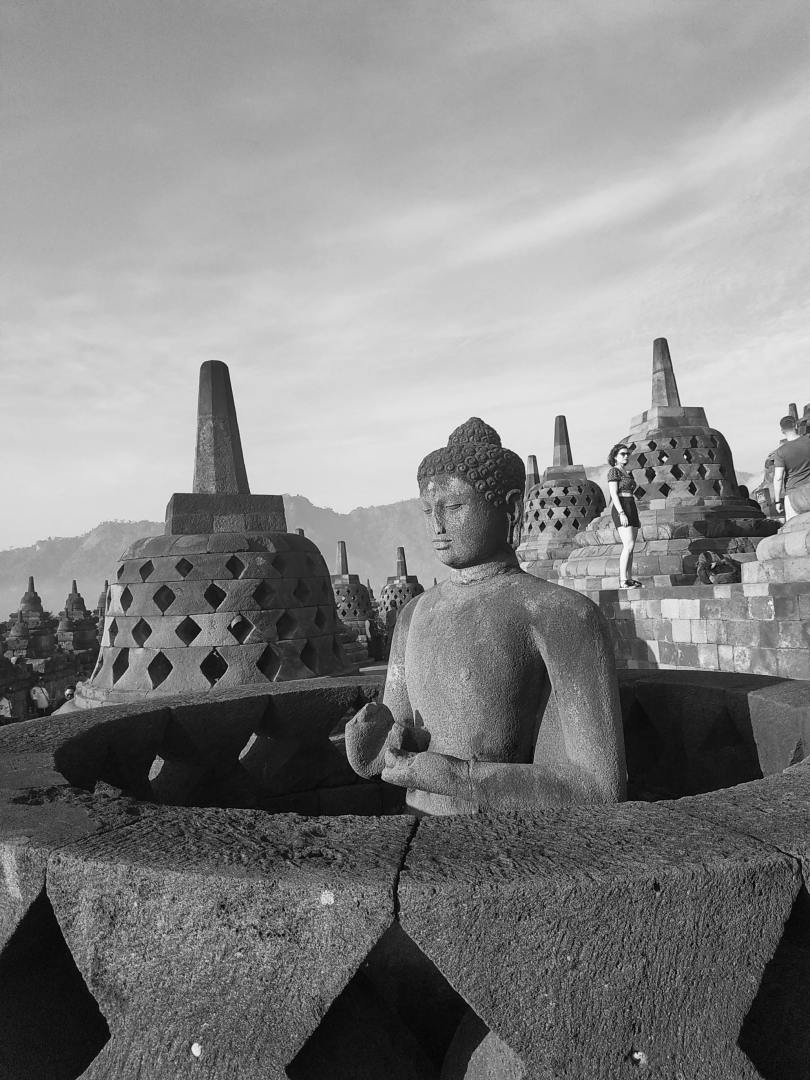
In the course of my life, I have been privileged to visit a few temples, most of them Buddhist, both those now in use and those that are now tourist sites. I’ve explored Borobudur in Central Java, seen the Emerald Buddha and the Reclining Buddha among others in Thailand. I’ve watched the monks and other worshippers in a temple in Xining. I’ve stood in the Pantheon in Rome and imagined what it was like when still dedicated to the Roman gods. I’ve seen the remains of other temples: in the museum in Cairo, in the Louvre, in the British Museum.
One thing that strikes me about temples is that you can’t miss who or what they’re dedicated to. There’s just no question. The decor, the behavior of the worshipers, and often the architecture itself makes it clear.
This is also true also of the Jewish temples, beginning with the tabernacle. My current Old Testament reading is in Ezekiel where he is being shown the temple. Those chapters remind me of the meticulous (and long) instructions God gives Moses for the tabernacle. Everything about the tabernacle is laid out clearly. Every bit of the design has purpose, all of it eventually centered on the Holy of Holies.
As Christians, we don’t build temples. We build gathering places. There’s a reason for that. We are told quite clearly that we ourselves are the temples.
Do you not know that you are God’s temple and that God’s Spirit dwells in you? If anyone destroys God’s temple, God will destroy him. For God’s temple is holy, and you are that temple.
1 Corinthians 3:16-17 ESV
Or do you not know that your body is a temple of the Holy Spirit within you, whom you have from God? You are not your own, for you were bought with a price. So glorify God in your body.
1 Corinthians 6:19-20 ESV
We ourselves are the temples of God, of the Holy Spirit? What does that mean for us?
The first passage is found in the midst of Paul calling out the Corinthians for claiming to follow Apollos or Paul instead of focusing on following Christ himself. Paul describes his work and that of Apollos as working to build the believers into buildings that will stand the test of fire. The implication here is that we are being formed into worthy temples of God.
The second passage comes after an extended diatribe against sexual immorality. Paul’s point here is pretty clearly: “Your body is a temple dedicated to the Holy Spirit. Don’t sin with it.”
A central concept underlying both of these points is this: if we are a temple of God, people should be able to tell. We must ensure that our bodies, and our entire selves, reflect the entity to whom we are dedicated. Our actions, our words, and everything else about us should represent the God we claim to serve and worship.
Just as any casual tourist can easily see that Borobudur was dedicated to Buddha and his teachings, those who interact with us should see who we belong to.
That goes beyond each of us as individuals as well, for it is not just each separate Christ-follower who is a temple.
So then you are no longer strangers and aliens, but you are fellow citizens with the saints and members of the household of God, built on the foundation of the apostles and prophets, Christ Jesus himself being the cornerstone, in whom the whole structure, being joined together, grows into a holy temple in the Lord. In him you also are being built together into a dwelling place for God by the Spirit.
Ephesians 2:19-22 ESV
Therefore, we must work, both within our own selves and as a body of believers, to ensure that we are growing into worthy temples who reflect God.
Photo by Leo Chandra on Unsplash
 Faith Musings