
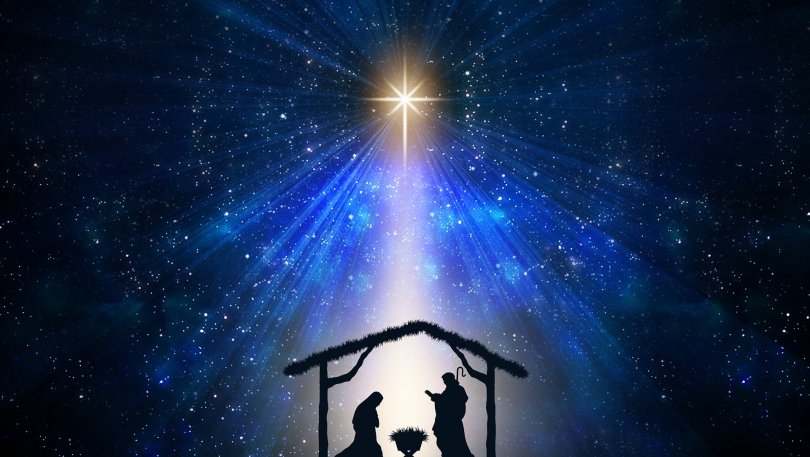
At this time of year, my local radio station transforms completely, playing only Christmas music from the day after Thanksgiving until December 26. I’m torn in my opinion of this change. I miss my usual soundtrack for driving, but the selections on the station have gotten better. After all, where else can I get a mix of traditional carols and more modern favorites of mine like “Joseph’s Lullaby” or “What a Strange Way to Save the World”? And I’m always delighted to hear holiday selections from the Trans-Siberian Orchestra.
My favorite thing about my particular radio station during Christmas time is the opportunity to hear newer Christmas songs from Christian artists, some of them quite thought-provoking. One song that has recently joined my list of modern Christmas favorites is “2000 Decembers Ago” sung by Joy Williams. While the title bugs me a bit since we know Jesus was probably not born in December, I think the song does a great job of capturing the wonder of the nativity. As I was listening to the song again recently, part of the chorus really captured my attention: “Was anyone able to look at the stable and not see a child but a King?”
I think the answer to that question at the time in Bethlehem was yes, at least in part. While Mary and Joseph probably saw a baby more than a Son of God at that moment, their experiences with the angels surely influenced their vision. And I believe the same is true of the shepherds. Certainly, when the wise men arrived (probably much later and not in the stable), they understood that they brought gifts to a king.
However, I think the important question for us is not about what people saw over 2000 years ago, but what we see today as we celebrate the birth of Jesus. Who do we see in the manger, and who are we celebrating?
We should, in part, see that infant. Think about who Jesus is and what his existence was like prior to his birth.
In the beginning was the Word, and the Word was with God, and the Word was God. He was in the beginning with God. All things were made through him, and without him was not any thing made that was made. (John 1:1-3 ESV)
Jesus was, and is, God. The Bible says creation occurred through him. That means he was able to simply speak things into existence. He gave that up to become a human baby. He not only suddenly had physical needs for food and warmth, but he was also entirely dependent on the humans around him to fulfill those needs with no means of communication about them besides crying. In choosing to become a fully human baby, Jesus went from being all powerful to being helpless.
Paul describes it this way: “Have this mind among yourselves, which is yours in Christ Jesus, who, though he was in the form of God, did not count equality with God a thing to be grasped, but emptied himself, by taking the form of a servant, being born in the likeness of men” (Philippians 2:5-7). How awe-inspiring that Jesus would choose such a dramatic loss for our benefit!
Yet, even if we see the baby Jesus in this light, we still miss the point if the sweet little baby is all that we see. We have to remember that Jesus had a purpose in coming to earth, and it wasn’t about being an infant to have lullabies song. His purpose was to show us sinless human life and ultimately to be our perfect sacrifice and then our Lord and King.
We have an advantage over those who were at the stable. We’re not dependent on hints from the angels about where the story is going. We get to read how it ends. As those who have a relationship with the resurrected Jesus, we have no excuse for failing to see the king in the manger or for forgetting that the whole point of Christmas is that Easter is coming.
Image by Jeff Jacobs from Pixabay
 Faith Musings