
In the Dark

One of the things I love about the Bible is that it’s not about sugar-coating anything. Christians sometimes (often) sugarcoat, but the Bible doesn’t. I was reminded of that while reading Psalm 88. It starts out, as many Psalms do, with a plea to God for help in trouble.

O Lord, God of my salvation,
   I cry out day and night before you.
Let my prayer come before you;
   incline your ear to my cry!
For my soul is full of troubles,
   and my life draws near to Sheol.
                                   Psalm 88:1-3 (ESV)

Now that’s not unusual. Many Psalms begin with such cries and end with praise to God.  The one that immediately comes to mind for me is Psalm 22, which begins in despair and ends with praise. Others include Psalm 3, 4, 6, 10, 13 . . . . I could keep going, but you’ve got the idea. However, Psalm 88 is a bit different. Here is how it ends.

But I, O Lord, cry to you;
   in the morning my prayer comes before you.
O Lord, why do you cast my soul away?
   Why do you hide your face from me?
Afflicted and close to death from my youth up,
   I suffer your terrors; I am helpless.
Your wrath has swept over me;
   your dreadful assaults destroy me.
They surround me like a flood all day long;
   they close in on me together.
You have caused my beloved and my friend to shun me;
   my companions have become darkness.
                                      Psalm 88:13-18 (ESV)

The psalmist is still in the dark, both in the sense of circumstances and in his understanding.

I see this as one of those places where the Bible gets very real and gritty. It’s a reminder that God does not promise a trouble free life to his people. He promises a joy filled life, a fulfilling life, but really also a trouble filled life. While he solves problems for us, he solves the ones he sees as beneficial to solve, and he solves them on his time. And, of course, his concept of beneficial is not always the same as ours. He left Paul with his thorn in the flesh for a long time.

This psalm is also a reminder that we must be faithful in crying out to God. The psalmist is in or at least near despair, but he cries out each morning. I find that very convicting. I have a few of those long-term prayer requests that God has yet to answer, requests that I’ve been praying over for 3-5 years. I think of these as the deepest cries of my heart, and they matter immensely to me. But after praying for a few years, I find myself occasionally missing a day of praying about them.

I also note that the psalmist is crying out to “God of my salvation.” Even in the dark, God is the source of salvation. He is, in fact, our only salvation. And we as Christ-followers have one huge advantage over the psalmist. We live in a time when we can know for sure that the darkness will end.

So we do not lose heart. Though our outer self is wasting away, our inner self is being renewed day by day. For this light momentary affliction is preparing for us an eternal weight of glory beyond all comparison, as we look not to the things that are seen but to the things that are unseen. For the things that are seen are transient, but the things that are unseen are eternal.  2 Corinthians 4:16-18

Are you in the dark right now? Will you commit with me to pray daily in that darkness and to trust in the coming light?


Photo by Nathan Anderson on Unsplash

Ramblings on Worship

I’ve been thinking today about worship for a couple of reasons. One spur came from responses to a Facebook post where I shared a call for people to volunteer for the production team at my church (the people who do lights, sound, video, the words on the screen, etc.). One reaction questioned the validity of production being juxtaposed with worship, but another suggested that doing the production work was itself a form of worship. Since I serve on the production team at present, that got me thinking about my worship and what my service means in terms of worship.

The second spark of thinking about worship came from my reading in Psalm 86 this morning. In the NIV I was reading, verse 11 reads, “Teach me your way, Lord, that I may rely on your faithfulness; give me an undivided heart, that I may fear your name.” In ESV, the same verse is “Teach me your way, O Lord, that I may walk in your truth; unite my heart to fear your name.”

So what do I think about worship? Like most people, I suspect, my immediate image of worship is singing my heart out to or for God. That is certainly the way I want to worship, since losing myself in a worship song, singing with abandon, is one of my absolute favorite things to do in this world. I think that’s why standing in front of the congregation and singing on a worship team is my favorite way to serve at a church. I get to do one of my absolute favorite things and call it service. However, when I think about offering a “sacrifice of praise” (Hebrews 13:15), I have to admit that there is not much sacrifice involved there for me. Maybe the time to prepare and learn a harmony part, maybe getting up a little early on Sunday and giving up more of my weekend than I would otherwise, but nothing in the moment.

Then I wonder, do I always really worship when I’m singing worship songs. And the answers is clearly a no. I probably am focused on God more often than not, but I certainly wander from the point at times. I start noticing that the words on the screen are coming too slow. I wonder what the person in front of me thinks of my singing. I start focusing on trying to pick up a particular harmony part in a less familiar song. If on stage playing keyboard or singing, I may get distracted by a wrong note and start to be self-conscious. All of these things divide my heart and keep me from fearing God, which is what worship is really supposed to be all about.

What about the suggestion that service on the production team really is a form of worship? I personally do CG, which means I run the videos, show any pictures, and control the words on the screens. This means that during the songs I am most definitely not losing myself in the music or singing with abandon. My job is to hit that spacebar at  the right time, precluding any loss of self, and the person I share a little room with would have just cause for anger if I sang with any volume. Thus it isn’t worship in the same sense.

But worship is about acknowledging God, fearing God, and serving God. Any sacrifice made for God is worship. That’s why giving is a part of worship. So perhaps sitting in the little back room making sure that people see what they are supposed to see is greater worship than any of my music making because it serves God, facilitating others’ worship and knowledge (during the sermons), and it involves a greater sacrifice than my singing ever does. I probably even have a less divided heart, because the decision to be there and do my best at the task is made long before.

present your bodies as a living sacrifice, holy and acceptable to God, which is your spiritual worship. Romans 12:1b 

How do you worship? What is your sacrifice? What divides your heart that God needs to unite so that you can fear him?

Photo by Bill Hamway on Unsplash

Growing

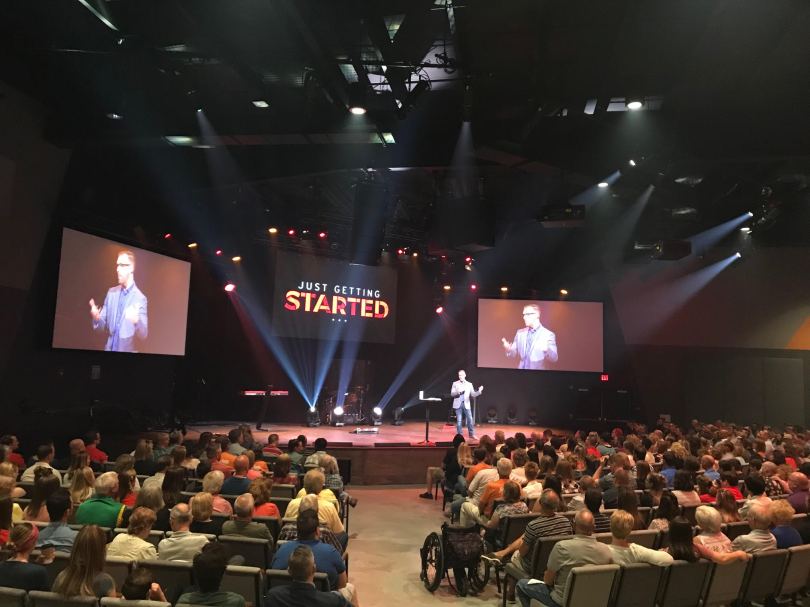
This past weekend saw my church’s first services in our new building. All five services, because the larger new auditorium isn’t actually enough larger to let us cut a service. Of course, the leadership thought it would be when we started building it. We knew that we’d be looking at multiple services, but we thought we’d be reducing the number. Instead the only change was shifting the two Saturday services to what we hope will be more attractive times so that we can move more people from Sunday to Saturday. After all, since we bought the land, average weekend attendance has grown by at least 50%, and it’s something like 5 times what it was just 5 years ago.

Reflecting on our growth and on the sermon from the weekend, which had to do with who God uses and being willing to answer the call, led me to thinking about why us. There are a lot churches in our area, so why are we the ones growing quite so dramatically and bringing the unchurched. I think there are a lot of reasons, and I know that trying to copy the how from one ministry to the next can be unproductive and even just unwise, but I do think there are a few things to be taken from what is working at Vale that could be applied in other churches and in our individual lives.

Of course, a key for any church is who the pastor is and what he does. I believe that’s certainly true for us. Our pastor is someone with a past that he has repented of and is not proud of, but one that he is open about. He tells his story without concern for sensibilities, but with great concern for sharing the love and power of Christ. He is also open about his current flaws and struggles and what God is doing in his life. Thus, he becomes a great picture of a real human being walking more and more closely with God, a picture that can only attract those seeking truth.

Our pastor also grounds all that he says deeply in scripture, and preaches expository sermons in an accessible way. I think many churches (and individual Christians) miss the mark on one of those two things. Sometimes we are so concerned about being attractive and accessible that we bury the message in so much fluff that the message itself gets lost or watered down even to falsehood. I think churches that do this find themselves pulling people in the front door, but eventually leaving through the back, their thirst for truth and God ultimately unsatisfied. And people too often find themselves lost because they begin to mistake the packaging for the message.

Of course, some churches and people go too far the other way. They may speak the truth, but they don’t worry at all about whether others can understand it. They lose track of the love God has for sinners and the importance of living a life that draws others to him. I once was talking to an elderly acquaintance about her church’s services, and I asked about a new person who might not know what to do and might be put off by that, and her response was that the person should go somewhere else. It broke my heart.

There are other elements that help Vale be what it is. Our music is contemporary but not overly edgy and not so loud as to be painful for this 50-something. Our church welcomes and uses its older members, encouraging us to be as much a part of the church as the 30-somethings that our music is more designed for. We have great children’s programming, and the new building has significantly improved our children’s facilities.

All things considered, though, I believe the key to Vale’s success, and to any church or Christian’s success in reaching others for Christ is really quite simple: share the truth of Christ, both personal and biblical, authentically and understandably. That may not be blessed with huge numbers, but it will blessed.

“Go therefore and make disciples of all nations, baptizing them in the name of the Father and of the Son and of the Holy Spirit, teaching them to observe all that I have commanded you. And behold, I am with you always, to the end of the age.” Matthew 28:19-20 (ESV)


Photo thanks to Amy Max