

Ending or Beginning

Winter graduation ceremonies were held last weekend at my university. Graduation is always one of my favorite days. I love seeing excited students and meeting proud parents. I particularly like the fact that my institution encourages faculty and student interaction. Every student walks across the stage (well, halfway across the stage) and is greeted at the bottom of the stairs by the president, the provost, the dean of the college or chair of the department (depending on which one handed the student his/her diploma cover) and the faculty from the department that are attending. It makes for a great celebration.

However, there is some question about what is we’re celebrating. Certainly, graduation is an ending. For bachelor’s students, it’s the culmination of around 4 years of hard work. For many, it’s the end of formal schooling. It often marks the end of dependence on parents. For many, it marks a truer end of childhood than either the 18th or the 21st birthday. It’s the end of spending much time with the faculty students have grown close to. It’s often the end of spending much time with the friends of the college years. Close and long-lasting as those relationships often are, they frequently become long-distance relationships at graduation.

As much as graduation is an ending, college and universities don’t typically bill it that way. We hold “commencement” ceremonies. Much as we want students to look back with fondness on their years with us, we want them to look at graduation as the beginning: the beginning of true adulthood, the beginning of a career, the beginning of membership in the alumni association, the beginning of making your own money so that you can start giving back to your alma mater (a bit cynical, but true). Why? Well, we want successful alumni who do have jobs and are happy and successful and inclined to give of their time and effort and money. And people are more likely to achieve that success if they look forward.

The same thing, I believe, is true of us as Christians. We can look at that moment when we put our faith in Christ as a sort of graduation from earthly life into a life of faith in the spirit. And our success in that new life may depend a bit on which way we are looking. It’s good to remember where we came from and what we owe Christ, but we are not encouraged to dwell there. We are to be dead to our old selves and living a new life. “Therefore, if anyone is in Christ, he is a new creation. The old has passed away; behold, the new has come” II Corinthians 5:17 (ESV). “But one thing I do: forgetting what lies behind and straining forward to what lies ahead, I press on toward the goal for the prize of the upward call of God in Christ Jesus” Philippians 3:13b-14 (ESV).

I could go on with verses along the same lines, but I think it’s more important for us to think about what it means to look forward. Most importantly, I think it means not dwelling on what we did. Yes, we want to recognize the tremendous debt we owed and were saved from, but focusing on the details and realities of our sins will not make us stronger and will not bring us joy. It’s more likely to encourage us to wallow in guilt, which is never of the Spirit. Scripture says God no longer sees our sin once he has forgiven it, seeing, instead, the righteousness of Christ, so why do we waste so much of our lives staring at it? Instead, let’s spend that time focused on the one who forgave those sins and deepening our relationship with and understanding of him.
Protesting All the Way

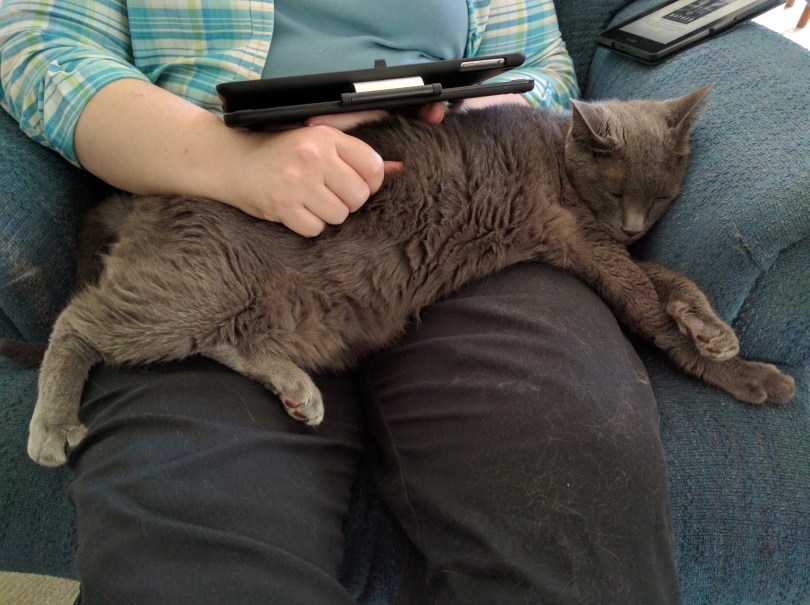
So we had to take the cat to the vet. Not for anything special, just her annual checkup and rabies shot. However, we did not enjoy the trip, mostly because she really does not enjoy the trip. From the moment she gets in the car until we are inside the vet’s office, she emits these plaintive meows every 2-3 seconds. Now the cat really doesn’t have anything to complain about. We don’t even put her in a carrier: she is sitting in my lap, her favorite place to be (yes, that is her in the picture, under my iPad). And she likes the vet just fine. There’s no complaining while we’re in the building. However, the minute we’re back in the car, she starts up again and cries all the way home, until someone opens the car door, at which point she races to the step up into the house and waits impatiently for a human to unlock the door and let her back into her house.

Some of you may be asking, “What do your cat’s issues have to do with your blog about faith?” Well, I think her primary problem is a control issue. While she is always willing to run out of the house and explore if an open door is left unattended, she hates being in the car and being moved by something other than her own muscles. Corners are especially distressing. It doesn’t matter that where she’s going is someplace she needs to go for her health (or back to the comfort and safety of her own home). She just doesn’t want to be taken in the car.

That issue with control is a problem that I think many of us share. We may want God to tell us where to go, but we then want to get there in our own way, often under our own power. We ask God to provide, but we want to see the provision in advance. We want to know that there’s enough for tomorrow and next week and next month and next year. We really would like to control when and how we hear direction from God, sometimes. I want to know why this happened, and I want to know it now. I want to know what my next job should be and when I should move on from this one, and I want to know that now. And when we don’t have the control we want, we don’t meow plaintively, but we do often worry and fret and pray the same demanding prayer over and over.

What we need to recognize is that God doesn’t work that way. God didn’t tell Abraham where to go: “Now the Lord said to Abram, “Go from your country and your kindred and your father’s house to the land that I will show you” Genesis 12:1 (ESV). Most of us are familiar with this story, but we often don’t think through the reality of it, so let me paraphrase. “Leave the place you know and all but your closest family and start moving. At some point, we’ll get to where we’re going and I’ll tell you to stop.” Wow.

Then what about the children of Israel in the wilderness? When they complained about lack of food in Exodus 16, God sent manna and told them to collect just enough for that day (except on Friday, when they were to collect enough for the Sabbath the next day as well). He told them to eat all they collected that day and not save any, except on Fridays. Of course, some of them wanted to make sure they would have food for tomorrow and saved some, which went really well: “Some left part of it till the morning, and it bred worms and stank” Exodus 16:31 (ESV).

God is not interested in giving us control over our lives, at least partly because he knows we do it badly. Instead, he wants to walk with us and provide what we truly need right now as we develop trust in him. He wants us to trust him when he takes us places and we’re afraid. He holds us close, just as I keep my poor cat in my lap, and he promises us his strength. Let’s be smarter than the cat, and trust the God who created and loves us (and is really in control even when we feel that we are).